ULoc: Low-Power, Scalable and cm-Accurate UWB-Tag Localization and Tracking for Indoor Applications
Abstract
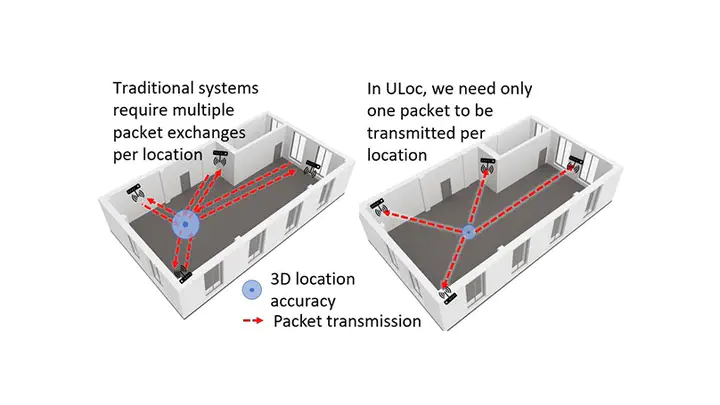
A myriad of IoT applications, ranging from tracking assets in hospitals, logistics, and construction industries to indoor tracking in large indoor spaces, demand centimeter-accurate localization that is robust to blockages from hands, furniture, or other occlusions in the environment. With this need, in the recent past, Ultra Wide Band (UWB) based localization and tracking has become popular. Its popularity is driven by its proposed high bandwidth and protocol specifically designed for localization of specialized “tags”. This high bandwidth of UWB provides a fine resolution of the time-of-travel of the signal that can be translated to the location of the tag with centimeter-grade accuracy in a controlled environment. Unfortunately, we find that high latency and high-power consumption of these time-of-travel methods are the major culprits which prevent such a system from deploying multiple tags in the environment. Thus, we developed ULoc, a scalable, low-power, and cm-accurate UWB localization and tracking system. In ULoc, we custom build a multi-antenna UWB anchor that enables azimuth and polar angle of arrival (henceforth shortened to ‘3D-AoA’) measurements, with just the reception of a single packet from the tag. By combining multiple UWB anchors, ULoc can localize the tag in 3D space. The single-packet location estimation reduces the latency of the entire system by at least 3×, as compared with state of art multi-packet UWB localization protocols, making UWB based localization scalable. ULoc’s design also reduces the power consumption per location estimate at the tag by 9×, as compared to state-of-art time-of-travel algorithms. We further develop a novel 3D-AoA based 3D localization that shows a stationary localization accuracy of 3.6 cm which is 1.8× better than the state-of-the-art two-way ranging (TWR) systems. We further developed a temporal tracking system that achieves a tracking accuracy of 10 cm in mobile conditions which is 4.3× better than the state-of-the-art TWR systems.
Supplementary notes can be added here, including code, math, and images.

Minghui (Scott) Zhao
Ph.D. Candidate in Electrical Engineering
My research focuses on developing embodied and embedded AI systems that enable intelligent agents to perceive, understand, and act in the physical world through hardware-software co-design and physics-informed machine learning.