LegoSENSE: An Open and Modular Sensing Platform for Rapidly-Deployable IoT Applications
Abstract
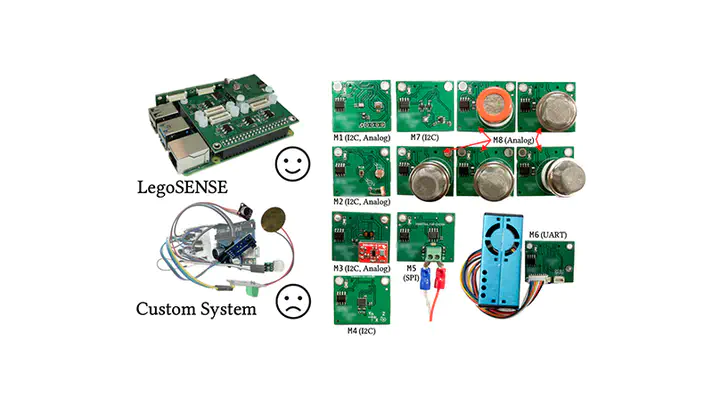
Domain-specific sensor deployments are critical to enabling various IoT applications. Existing solutions for quickly deploying sensing systems require significant amount of work and time, even for experienced engineers. We propose LegoSENSE, a low-cost open-source and modular platform, built on top of the widely popular Raspberry Pi single-board computer, that makes it simple for anyone to rapidly set up and deploy a customized sensing solution for application specific IoT deployments. In addition, the ‘plug and play’ and ‘mix and match’ functionality of LegoSENSE makes the sensor modules reusable, and allows them to be mixed and matched to serve a variety of needs. We show, through a series of user studies, that LegoSENSE enables users without engineering background to deploy a wide range of applications up to 9× faster than experienced engineers without the use of LegoSENSE. We open-source the hardware and software designs to foster an ever-evolving community, enabling IoT applications for enthusiasts, students, scientists, and researchers across various application domains with or without prior experiences with embedded platforms or coding.
Supplementary notes can be added here, including code, math, and images.

Minghui (Scott) Zhao
Ph.D. Candidate in Electrical Engineering
My research focuses on developing embodied and embedded AI systems that enable intelligent agents to perceive, understand, and act in the physical world through hardware-software co-design and physics-informed machine learning.